Derivation: Acceleration of the System
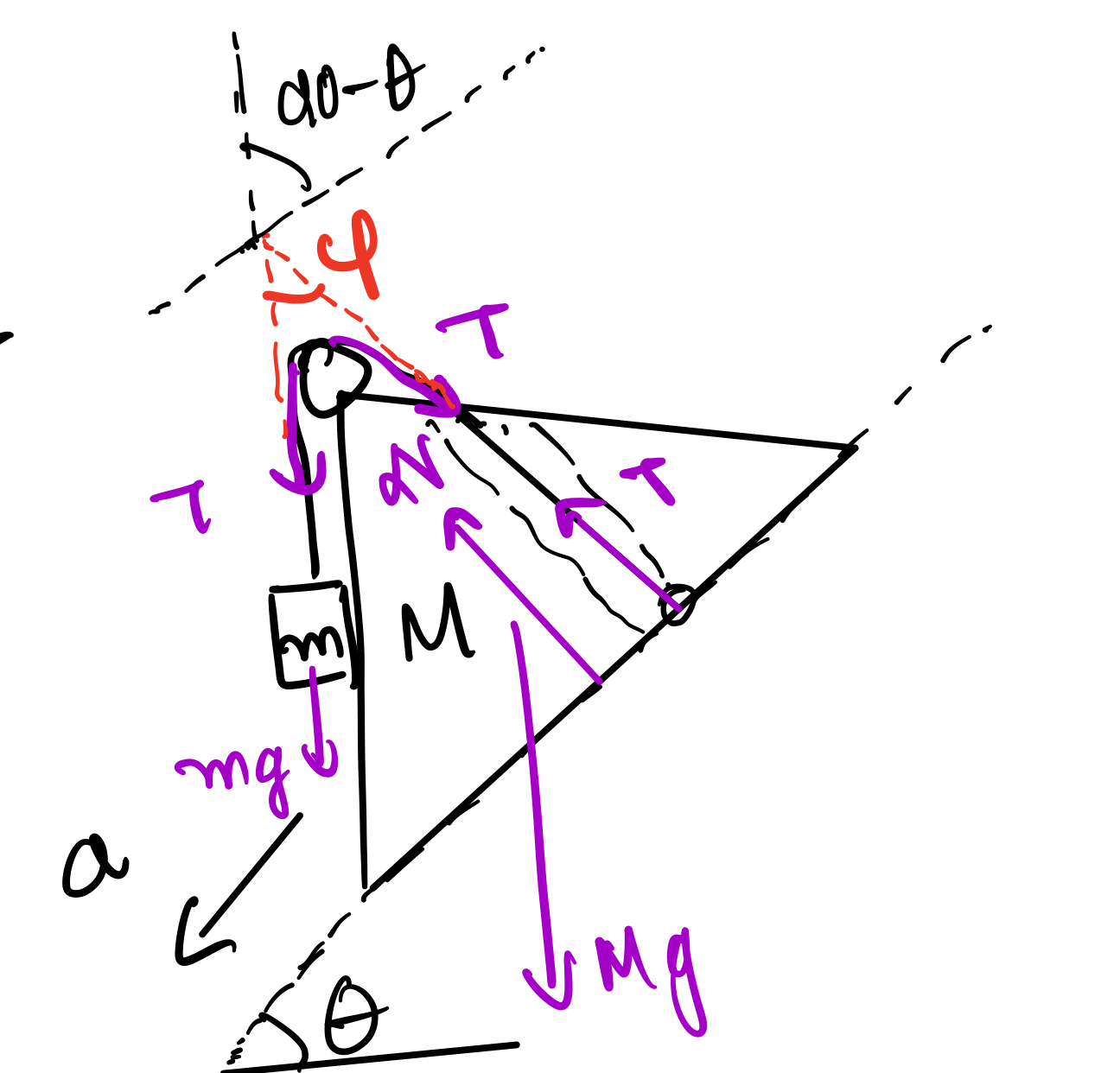
1. Equations of Motion
Considering the forces acting on the system along the incline and perpendicular to it:
(I) Equation along the incline (System):
$$ (m+M)g \sin\theta - \mu N - T \sin(\phi - \theta) = (m+M)a $$(II) Normal Force Equation:
$$ N = (M+m)g \cos\theta + T \cos(\phi - \theta) $$(III) Constraint Equation (Hanging Mass):
$$ mg - T = ma \sin\theta $$ $$ \Rightarrow T = m(g - a \sin\theta) $$2. Substitution and Solving
Substitute the expression for \( N \) from (II) into (I):
$$ (m+M)g \sin\theta - \mu [(M+m)g \cos\theta + T \cos(\phi - \theta)] - T \sin(\phi - \theta) = (m+M)a $$
Rearranging to group terms associated with Tension \( T \):
$$ (m+M)g \sin\theta - \mu(m+M)g \cos\theta - T [\mu \cos(\phi - \theta) + \sin(\phi - \theta)] = (m+M)a $$
Note: Since the string is attached to a light ring, there shouldn't be any component of tension along the rod, so it should be perpendicular to the rod . This implies \( \phi = \theta \).
Therefore: \( \cos(\phi-\theta) = 1 \) and \( \sin(\phi-\theta) = 0 \).
Therefore: \( \cos(\phi-\theta) = 1 \) and \( \sin(\phi-\theta) = 0 \).
The equation simplifies to:
$$ (m+M)g (\sin\theta - \mu \cos\theta) - \mu T = (m+M)a $$
Substitute \( T \) from (III) and solve for \( a \):
$$ a = \frac{g [ (m+M)(\sin\theta - \mu \cos\theta) - \mu m ]}{m + M - \mu m \sin\theta} $$
3. Final Result
Condition for motion (\( a > 0 \)):
$$ \mu < \frac{(m+M)\sin\theta}{m + (m+M)\cos\theta} $$